Message is the heart and soul of brand. Industry experts, agency leaders and leading CEOs know that putting message first is the only approach that delivers the best results for their marketing.
But sometimes, businesses don’t find a strong key message. Sometimes whole industries play it safe and say the same things in the same way. And that’s a problem.
When everyone sounds like everyone else, nobody sounds like anything at all.
The Industry: Cybersecurity
Some industries demand huge investment in messaging because they know they have to create desire. It’s no coincidence that brands that take risks to grab attention are the ones with exciting, dynamic and memorable messages. They understand that their audience don’t yet know they need their services and move heaven and earth to change that.
Then you have other industries. Industries that know their customers have a need for their products and services. Maybe it’s for compliance reasons. Maybe it’s a legal requirement. Brands operating in these spaces are the ones happiest to sit back, not rock the boat, and let the customers trickle in as they may.
Cybersecurity is a prime example.
Businesses need cybersecurity. Protecting systems, data, transactions – it’s not a nice-to-have. It’s a have-this-or-don’t-have-a-business kind of proposition.
So with no need to go out and sell the concept, cybersecurity brands don’t feel they need to go to the effort and expense of having a key message that differentiates them.
They all sound like each other. Which means that nobody sounds like much of anything at all.
The Played Out Messaging
There are certain things every customer will expect to see from their cybersecurity provider. Yes, they want you to protect them, to mitigate risk, to secure data. They want you to use the right tools, to embrace AI, to be aware that things are always changing.
But do you have to make your messaging identical to everyone else in the sphere?
Here’s a checklist of messaging elements that it seems like every cybersecurity company defaults to.
“Overcome evolving threats”
Cyber crime is constantly changing. Cybersecurity has to respond to that. It’s an essential pain point for any cybersecurity company to address if they’re building trust with clients. But the problem comes when everyone talks about in the moving threat landscape in the same way.
With the same word.
When it comes to messaging, for the vast majority of brands it seems like evolving is the go-to-term.
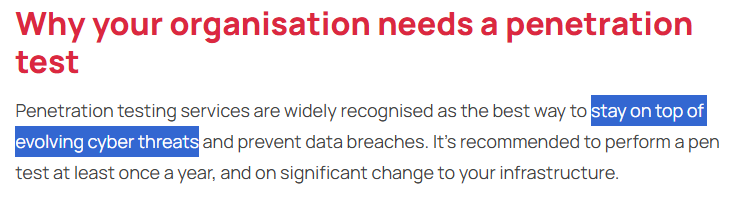
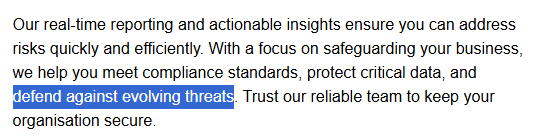

If it wasn’t for the typefaces switching, you could be forgiven for thinking all of these examples are from the same site.
An essential pain point reduced to so much white noise because of identical messaging.
Three companies in three locations around the world. Three brands leaning on evolving threats. Not even a risk in there to break the tedium. How can you choose between them?
“Beyond detection”
A good cybersecurity company won’t just alert you to a risk. They’ll move to fix gaps in your security systems, safeguard data, and keep you up-to-date with compliance.
There’s a lot a cybersecurity company can do for you. The full suite of services that they can offer is a key differentiator in a crowded marketplace.
Surely the range of services could be a fast, effective way to stand out from the crowd? Not when there’s seemingly only one way to explain it.


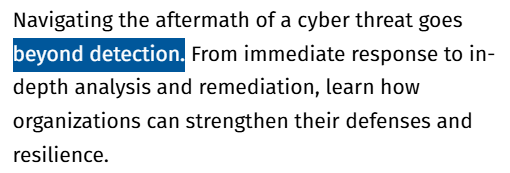
(Of course, if you really want to stand with the crowd, you can add in a little evolution as you go beyond detection…)

The additional services, competencies and features a cybersecurity company can offer should be a genuine competitive advantage. Instead, the key messaging pillar that your company can do more is camouflaged by the fact that when everyone is going beyond, everyone is still ending up in the same place.
It’s a line customers will look straight past.
“Your partner”
This extra-special cybersecurity company isn’t a service partner. They’re committed.
They’ve got skin in the game. They’re working hand-in-glove with you. They’re the reassuring friend at your back. They’re the spartan in the shield wall next to you. They’re the Samwise to your Frodo. The Chewie to your Han. The B.A Baracus to your Hannibal Smith. Your bosom buddy. Your sword against the darkness. Your relentless shield. Your bulwark against the encroaching tide of crime and misery lapping at your data doorway.
You get the picture.
There’s lots of ways they could explain that they’re right here by your side with an ongoing relationship to keep you safe.
But they don’t.
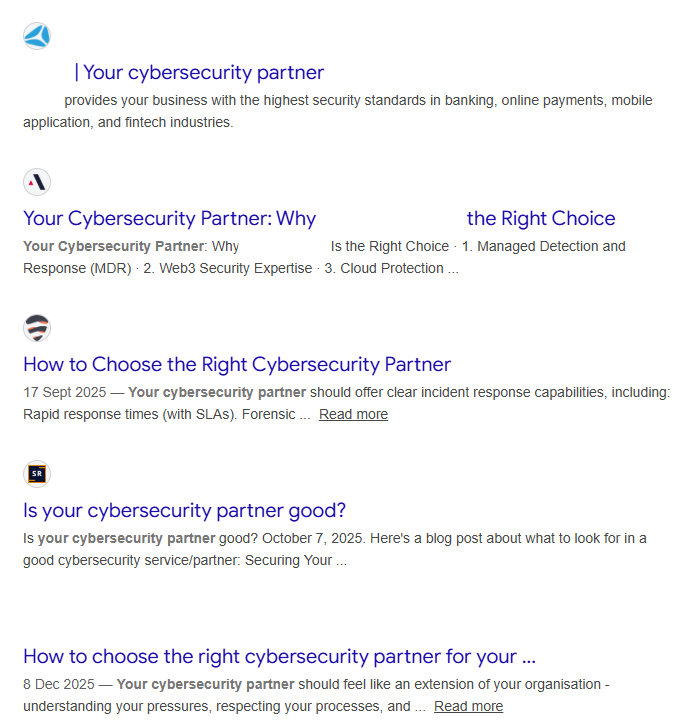
Add in a propensity for jargon and an inability to engage with any of the emotional reasons behind choosing a cybersecurity company, and you end up with a boilerplate message that creates a boilerplate positioning with a boilerplate lack of personality.
Your quick guide to sounding like every other cybersecurity company
It’s simple. You follow a straightforward framework, and you use the exact same language choices as everyone else.
- Make a basic claim (“we stop/prevent/protect”)
- Amplify the fear (“threats are evolving”)
- Throw in a few platitudes (“your partner in security”)
- Offer more, but underplay it (“going beyond”)
- Pile the jargon high (“AI-powered zero-trust cloud-native”)
Or, sound like your own business by putting your message first.
The Excuses
Standing out from the crowd can be intimidating. After all, if all these other cybersecurity businesses are getting customers, surely the standard messaging framework works, right? Why rock the boat and risk falling out?
But fear isn’t the reason most cybersecurity businesses sound like most cybersecurity businesses. They have a rationale for using a neutral tone and repeating the same platitudes as everyone else. They reasoned themselves into this trap – and you can reason your way out.
We’re talking to techie people
Cybersecurity companies are targeting heads of IT and digital transformation. Chief technology officers. Other experts in the field, who don’t have the time, tools or resource to build a security system from scratch. So there’s a reluctance to do anything that could be seen as talking down.
“Our customer is a tech expert who wants an AI-powered threat assessment system that goes beyond detection handled by a trusted security partner. So we tell him that’s what we do, and leave him to make the right decision.”
That’s one way of looking at it. But your customer is also a time-poor expert with overstretched resources who wants to be able to walk into the CFO’s office and explain why your service is worth the investment without having to explain all the jargon.
They’re also a human being. They don’t live and breathe tech 24/7, and want to see something fun, something memorable, something different.
A message that resonates with that emotional pain point helps your customer escape the race to the bottom that comes when a CFO is given seemingly identical options where the only difference he can see is price.
Our competitors do roughly the same things – we don’t compete on brand
There’s a misconception in lots of B2B sectors that brand is something that’s reserved for consumer-facing products and services. Business decisions aren’t made using the same part of the brain as buying a new phone, a new car, a new kind of chocolate bar. It’s all rational. All you need to do is calmly state the facts and your obviously superior product will be chosen. (It’s called the Product Delusion – and it’s common across B2B)
“Our customer knows what she needs. She will look at all of our competitors, and choose the one provider that offers a specific service that she’s looking for.”
Unfortunately, the world doesn’t work like that. If decisions are made solely on the specifics of a service, your customer would just search for the exact tool or support she needs, compare the prices of the first three, and choose the cheapest. Again, you’re in a race to the bottom.
But, this is her career on the line. A data breach, a hack, malware taking the systems down for a day – the buck stops on the head of IT’s desk, and when it stops, it often brings a jet-propelled P45 with it.
If she knows all your competitors do broadly the same things, but your message is one of personal protection, of safeguarding and compliance, that’s going to land better than a list of services with a fee at the bottom.
The Brands Breaking the Mould
Cybersecurity is a messaging desert. The search results above prove that. But some brands are breaking out of the straightjacket and finding new messages to connect with customers in a different way. They’re avoiding the race to the bottom and demonstrating real value.
Value that translates into more sales and better rates.
Rubrik’s muscular confidence
Never mind your cybersecurity partner. Rubrik’s your bodyguard. They’re punching, fighting and karate-chopping their way through digital attackers to keep you safe. Like a cloud-based John Wick. That impression of always-on watchfulness and furious commitment, combined with a more purposeful tone that cleaves close to firestarter, cuts through the noise in a way that going beyond detection never could.

They aren’t just aware of risk. They’re bothered by it. Shocked by business complacency. Driven to fix it.
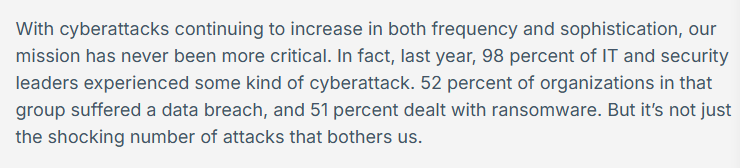
And when they veer close to jargon, they immediately couch it in language a CFO could understand. Ian in the financial department may not be familiar with zero trust architecture, but he understands the benefits of getting your data back and keeping his business running.

This message of being your data bodyguard is threaded through the site. They don’t “go beyond detection,” they investigate and hunt threats to stay ahead of attacks.
Much like a bodyguard, they’re looking for potential issues and kicking them in the bollocks.

Since going public in April 2024, Rubrik has nearly tripled its market value to over $15 billion. ARR has grown from $400 million in 2022 to $1.35 billion in 2025. While competitors lean on the same tired fear messaging, Rubrik’s distinctive message and positioning helped create a brand investors (and customers) pay a premium for.
Coincidence?
I don’t think so.
The best defence is a good offence with Praetorian
In a similar vein, Praetorian evade the trap of passive, dull messaging the same way they evade cyber threats. By going on the offensive. They’re on a war footing, taking the fight to cyber criminals with a cabal of security experts that sound less like your partner and more like the A-Team.
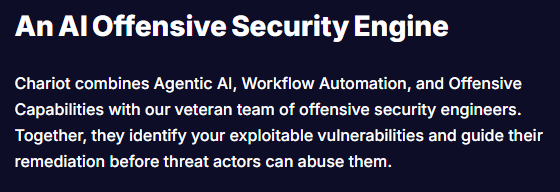
This military approach extends to their platform features and service names too, addressing the essential pain point of offering more without defaulting to “going beyond detection.” Penetration testing might be the term that an IT manager uses, but by framing it as a wargame, Praetorian give their customers more agency and make them feel like they’re taking the fight to the criminals.

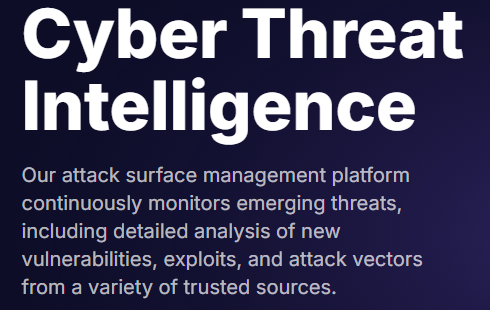
Threat detection? Sounds boring. Attack surface management sounds like something you’d get from a military intelligence provider. It’s empowering. It’s emotional in a way that going beyond could never be.
Finally, take a look at their core values. Are they hiring techies, or are they looking for someone to join their commando unit?

It’s a messaging angle that stands out from the crowd. There’s no risk of Praetorian sounding like anyone else.
And here’s what that looks like as business evolution.
The company bootstrapped to profitability over eight years before taking outside investment – and when they did, it was McKinsey that came calling. The consulting giant rarely invests in startups, but cited Praetorian’s “distinctive capabilities” and “strong brand reputation” as the draw. That brand is all built on message.
Military-grade messaging – proof you don’t need a billion-dollar war chest to stand out.
Both Rubrik and Praetorian hit the beats you’d expect. Partnership, protection, technical excellence. But they use a message, an identity and a tone to elevate their pitch and differentiate themselves without having to resort to being cheaper.
If you’re serious about taking your cybersecurity company to the next level, you need to consider how to stand out from the competition in a sea of similarly uninspiring content.
The answer’s simple. You start with the right message.
The messages to avoid:
- Evolving threat
- Beyond detection
- Your partner
The standard tone: Simplifier/Neutralizer
The opportunity: To stand out in a crowded marketplace by being one of a
vanishingly small number of genuinely recognisable
cybersecurity brands that put message first.
Putting your message first is so clear. So effective.
So what are you waiting for?



Related articles

The Foundations of Message First Marketing

Finding your key message? Putting it first?
That’s easy to do, when you put all the foundations in place with our three-step message first methodology.

The Unbeatable Benefits of Message First
Clear, focused brand messaging makes a huge difference. It drives results. And when you put message first, the benefits are even clearer….as you’ll see.

Why Most Marketing Doesn’t Work

71% of marketers think they sound different (but don’t). Learn how to stand out in a sea of sameness.